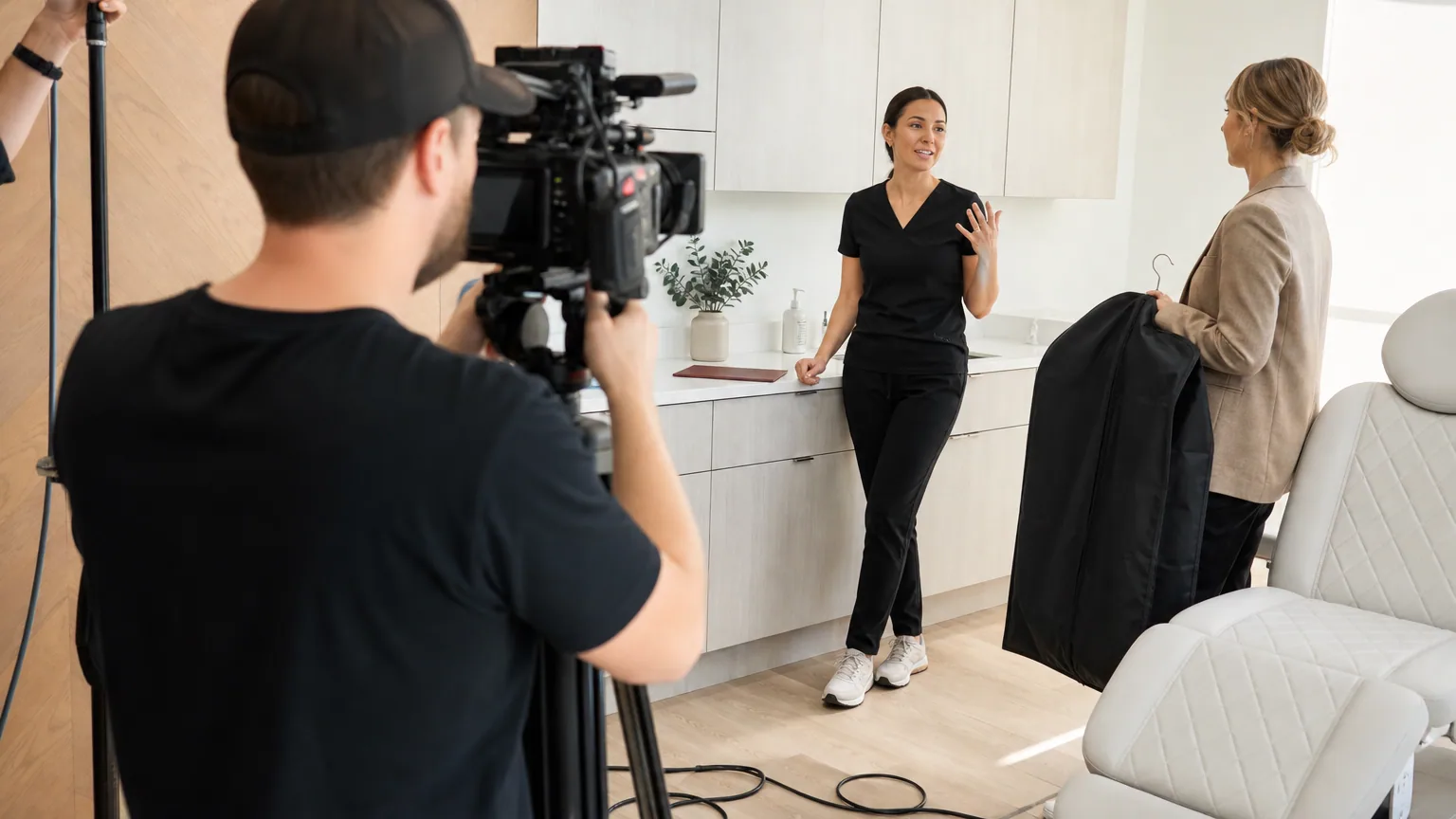
Most practices that feel behind on content are not behind on ideas. They are behind on supply. If you post three to five times a week on one platform, you need roughly 13 to 22 finished assets a month, and that is before paid creative, website refreshes or a second platform. One brand shoot a year cannot cover that, and no amount of editing can stretch it. The fix is not a bigger shoot budget. It is a production calendar: a half day every four to six weeks, built around treatment rooms, provider availability and signed authorizations.
Here is what a year of content actually costs you in clinic time, and how to run it so it never touches patient flow.
The real math nobody does
Industry guidance for clinics lands in a consistent range. Pabau advises three to five posts a week on your main platform, and notes that a steady rhythm beats an occasional burst followed by weeks of silence. Decoda Health puts the same three to five posts per week as a realistic target for independent practices, and makes the sharper point that on Instagram, posting three times a week every week outperforms seven posts one week and two the next.
Do the arithmetic.
- One platform at three to five posts a week: roughly 13 to 22 finished assets a month.
- Add a second platform and Stories: by our estimate, the monthly requirement lands somewhere in the 30 to 60 range.
- Before paid creative. Before a single new photo on the service pages.
At the low end, that is more than 150 finished assets a year. Now add the constraint that makes it harder: Decoda Health's rule that only one in five posts should be promotional, because the other four build the credibility that makes the promotional one convert. So four out of five assets have to be substance. Provider explanation. Real treatment footage. A patient who says something true in their own words.
Substance is exactly the thing a single shoot day cannot stockpile.
Why the annual brand shoot runs dry by week six
You know the pattern. The crew comes in, the clinic is immaculate, everyone is in fresh scrubs, and you get a beautiful gallery: the hero shot of the building, the provider portraits, the slow pan across the treatment room. For about six weeks it carries everything. The website looks new, the feed looks expensive, the ads have fresh creative.
Then it goes flat, for three reasons.
The looks are frozen. One day means one set of outfits, one lighting setup, one hair and makeup pass. By week six, the audience has seen every variant. Paid creative dies fastest here because the same faces in the same room run against the same audience over and over.
There is nothing current in it. You cannot shoot a May message in October. A shoot in one week cannot speak to what patients are actually asking about in the weeks that follow, or to the treatment you started offering in the second quarter.
The substance ratio is wrong. Brand days tend to produce beautiful atmosphere and very few provider explainers, because explainers need scripting, time and a provider who is not between patients. So you end up with a gorgeous library that cannot fill four out of every five slots.
That is why practices on an annual cycle spend ten months of the year posting whatever someone grabbed on a phone, which is a different brand to the one you paid to build.
Half a day, every four to six weeks
The cadence that actually works for a working clinic is a half day every four to six weeks. Not a full day. Not quarterly. Half days are the only unit that fits a schedule with patients in it, and the four to six week interval is what keeps looks and messages current.
The planning is operational, not creative:
- Block the rooms, not just the time. Pick the half day from the schedule your front desk already knows is lighter. One treatment room goes offline for the shoot, the rest keep running.
- Prep the providers before the day, not on it. They get their talking points in advance, two or three questions each, in their own language. A provider improvising on camera between patients produces unusable footage and resents the whole exercise.
- Front-load wardrobe and set dressing. Two or three outfit changes in a half day multiplies your usable looks at almost no cost in time.
- Shoot for six weeks, not for today. You are not filling this week's feed. You are filling the gap until the next half day.
What a single disciplined half day produces: provider explainers covering the questions patients actually ask at consult, treatment b-roll with hands and devices and product, results footage, room and front-of-house atmosphere, and one or two patient testimonials if you have consent in hand. Cut properly, that is six weeks of social, the creative rotation for paid, and refreshed imagery for the site, from one morning.
Consent is a production step, not paperwork you chase later
This is where most practice content pipelines stall, and the rules here are not marketing opinion.
Patient photos are protected health information. The healthcare law firm Jackson LLP notes that patient photos belong in the patient's designated record set, and that before-and-afters often carry age or the type of treatment performed, which is protected by HIPAA and state medical privacy laws. Before sharing for any purpose besides your treatment of the patient, you need the required authorizations, and the details of those authorizations vary by state.
Routine treatment consent does not cover you. For external use on your website, social or ads, a routine consent to treat is not the same document as a written authorization to use photos in marketing, and a general model release alone is not enough where PHI is involved. What a valid authorization has to contain varies with how HIPAA is applied alongside your state's medical privacy law, so your own counsel is the one to build and review the form before you shoot.
Three things practices routinely miss:
- Vendor agreements. Ask your counsel whether your photographer and your agency need Business Associate Agreements, with defined permitted uses and retention, for the patient material they handle.
- Revocation. Confirm with counsel how a revocation must be handled for material already published, then keep a tracked asset library where you can find every file tied to a patient in minutes.
- Storage matters. Jackson LLP notes that digital cameras relying on MicroSD or traditional SD memory card storage usually lack HITECH Act compliant encryption, so they cannot be used for storing patient photos or information.
One more detail that belongs to the crew, not the compliance binder: whether an edited or altered patient photo can be posted varies with the rules your practice is held to, and with what the alteration is doing, so ask your counsel where the line sits before anything is retouched for publication. And treat anything publicly viewable the same way: a website, a social feed or even a group email puts patient images in front of people the authorization may not cover, so confirm with your counsel what each of those placements requires.
Which is why consent belongs on the production schedule as its own step, with a named owner, signed before the camera comes out rather than chased afterwards.
What to shoot when patients will not go on camera
Plenty of your best cases will never appear, and that is fine.
What counts as de-identified is a legal determination, and it varies with the rules your practice is held to, so it belongs with your counsel rather than being settled on set. Practically, that means building the shoot so nothing identifying is captured in the first place: crop or mask faces and unique identifiers such as tattoos and scars, stage neutral backgrounds, and strip EXIF and GPS metadata using non-descriptive file names.
Watch the background, because it can turn a clean image into PHI: clinic signage, street views visible through a window, staff name badges, a calendar with visit dates. That is a set-dressing instruction for every treatment-room shoot, not an edit you fix later.
Then build the half day so patients are optional. Provider-led explainers, device and technique b-roll, product and texture, hands at work, front-of-house and ritual, staff on camera talking about what they see every week. A practice with zero patient appearances can still fill a six-week calendar entirely. The patient footage is the bonus, not the foundation.
Judge it by consults, not followers
The measure that matters is not reach. It is how many consults booked and which asset the patient named when they called.
Add one question to your intake script: what made you reach out. Log the answer. Within two cycles you will know which three pieces of content are doing the work, and your next half day gets built around those, not around what looked good in the gallery. That loop is what makes content compound. Without it you are producing volume and guessing.
At Prime Aesthetic Media we run this as a system: the shoot calendar, the consent workflow, the editing and the posting, with content mapped to the moments patients actually decide. It is the same approach behind the video work that took one practice's conversion from video touchpoints to 18 times its former rate, and the social strategy that carried another past five million views. If keeping a year of content fed is currently landing on whoever has a free afternoon, that is a production problem, and it is a solvable one. Start with a free 15 minute call.
Frequently asked questions
How many posts a month does a med spa actually need?
Guidance for clinics consistently lands at three to five posts a week on your main platform, which is roughly 13 to 22 finished assets a month. Add a second platform and Stories and our estimate puts the requirement in the 30 to 60 range, before paid creative or website updates. At the low end that is more than 150 finished assets a year, which is why cadence, not ideas, is the real constraint.
Why is one annual brand shoot not enough?
A single day gives you one set of looks, one lighting setup and no ability to speak to what is current six months later. It also tends to produce atmosphere rather than provider explainers, and only one in five posts should be promotional, so four out of five slots need substance you cannot stockpile from one morning. A library built in one day tends to carry about six weeks before it starts repeating.
How much clinic time does a recurring shoot cost?
A half day every four to six weeks, with one treatment room blocked while the rest of the schedule keeps running. Pick the half day your front desk already knows is lighter, prep providers with their talking points in advance, and plan two or three outfit changes. Done properly that half day produces six weeks of social, paid creative rotation and refreshed site imagery.
What consent do we need before posting patient photos?
For external use on your website, social or ads, HIPAA generally requires a written Patient Authorization, which is more specific than a routine consent to treat, and a general model release alone is not enough where PHI is involved. It should describe the specific photos and purposes, name who may receive or use them including marketing vendors, carry an expiration, state the right to revoke in writing, disclose any remuneration, and be signed and dated. Requirements vary by state, so have your own counsel review your form.
What can we shoot if patients will not appear on camera?
Almost everything. Provider explainers, device and technique b-roll, product and texture, hands at work, front-of-house ritual and staff talking about what they see each week will fill a six-week calendar on their own. Where you do use de-identified images, what counts as de-identified varies with the rules your practice is held to and the determination belongs to your counsel, so shoot to avoid identifiers in the first place: crop or mask them, stage neutral backgrounds without signage or badges, and strip metadata.